These figures reflect our activity in 2024.
Page updated in June 2026
%
Intact perineum
%
Intact perineum and abrasions
%
Episiotomy
7%*
%
Delayed clamping of less than 1 minute
… and more than half a minute for caesarean sections
13%*
%
Choice of delivery position *
* This figure has been included in the figures for 2023
… And more than half for spontaneous births
Except in emergency situations, we work as a team to offer women the freedom to choose their birthing position. All positions are possible; our rooms and delivery beds offer a wide range of adjustable options (on one’s side, squatting, on all fours, modified gynecological position, etc.).
%
Unassisted childbirth
42%*
%
Vaginal delivery after a cesarean section
34%*
%
Breastfeeding
Spontanée en siège
%
Spontaneous vertex delivery
68%*
%
Planned cesarean section
9%*
%
Spontaneous breech delivery
1,1%*
%
Vacuum extraction
9%*
%
Unplanned cesarean section
12%*
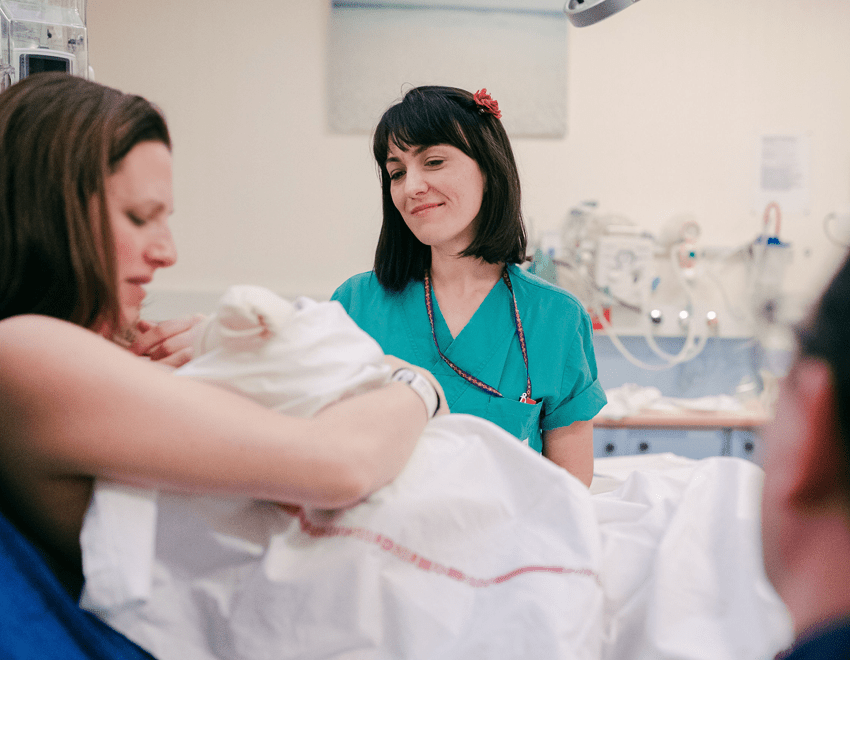
Women gave birth to their babies with the assistance of a hospital-based midwife
Our maternity unit at Saint-Pierre University Hospital is classified as a Level 3 facility, meaning that its expertise and infrastructure enable it to manage all types of pregnancies, even the most complicated ones. Our goal is to respect our patients’ wishes and the natural process of childbirth while taking medical realities into account.This explains why we are able to maintain a stable and low cesarean section rate despite the number of high-risk pregnancies we manage.
Goal: Strengthening the Bond Between Mother and Baby
%
We do everything we can to ensure and maintain the parent-child bond, as well as skin-to-skin contact. This is true even in the case of a cesarean delivery. In this case, the support person may be present throughout the cesarean procedure, and the newborn is placed directly on the mother for skin-to-skin contact.
Skin-to-skin contact is maintained continuously during the first few hours after birth, provided the baby is healthy enough. It can take place either on the mother or on the other parent.
*Methodology:
For comparison, the average rate for Brussels is provided in parentheses when the data comes from the 2020 report by the Center for Perinatal Epidemiology.
The other data is systematically collected from our records to present information focused on the physiology of childbirth but cannot be compared to the rates in Brussels.
** Les interventions sont:
– induction (with prostaglandins, oxytocics, or artificial rupture of membranes, balloon)
– epidural
– forceps or vacuum extraction
– cesarean section
– episiotomy